
Why Employee Breaks Take Longer Than Planned (And How Workplaces Fix It)
Break times expand for predictable reasons tied to environment design, not motivation.
Introduction: Most Break Problems Aren’t Discipline Problems
Managers often notice employees taking longer breaks than scheduled.
The immediate assumption is disengagement or poor time management.
In many workplaces, however, the environment, not the employee, determines how long a break lasts.
Break duration is influenced by friction.
The Friction Effect
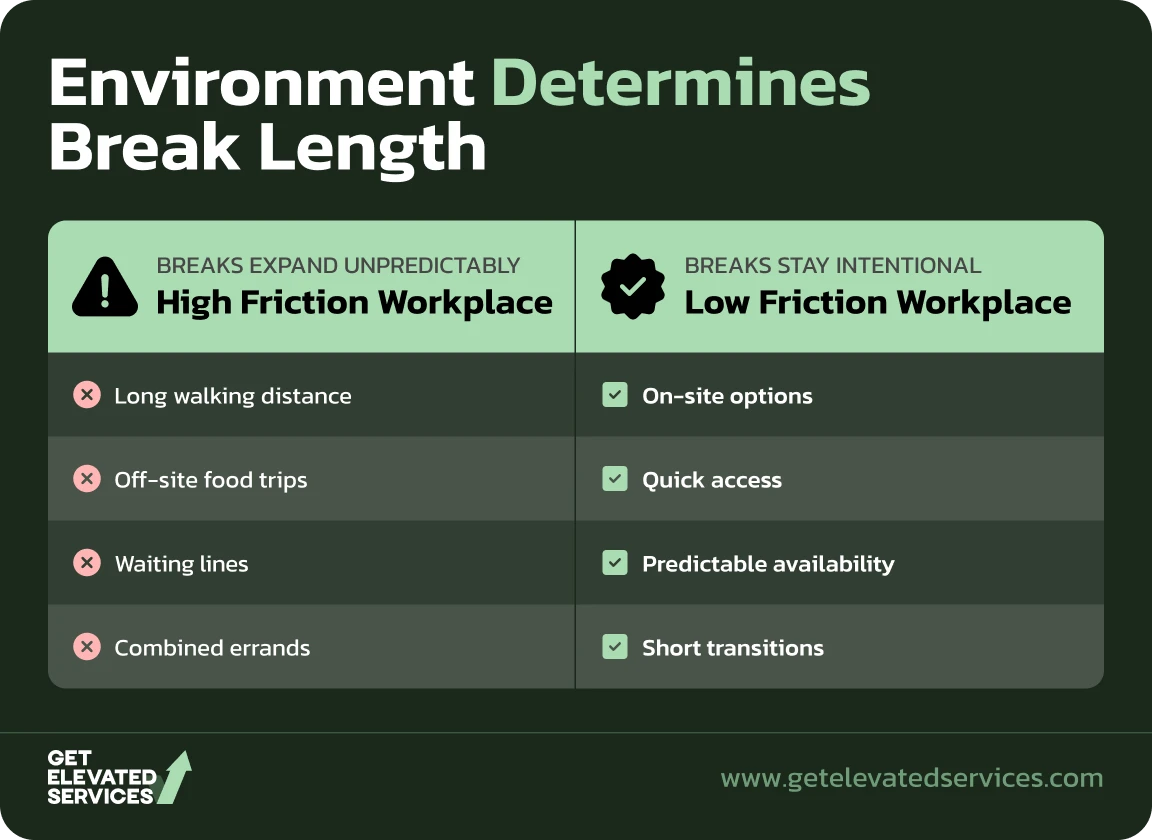
When employees need to leave their workflow to meet routine needs, each step adds time:
- walking distance
- waiting in line
- traveling off-site
- coordinating with coworkers
Even short interruptions extend naturally because returning to work requires re-orientation.
The “Might As Well” Behavior
Once employees leave the workflow, they often combine tasks:
“I’m already away, I’ll handle other things.”
This is not intentional misuse of time. It’s efficient behavior in response to inconvenience.
The longer the distance from work tasks, the longer the return time.
Why the Return Takes Longer Than the Break
The brain needs transition time after interruptions.
Employees must:
- re-focus
- reload context
- restart mental processes
So a 10-minute break often becomes 15–20 minutes of lost workflow continuity.
Predictability Changes Behavior
When employees know resources are nearby and reliable, behavior shifts:
- breaks stay shorter
- trips become intentional
- schedules stabilize
- teams stay synchronized
The environment shapes routine more than policy.
Operational Impact
Extended breaks affect more than individual productivity:
- meetings start late
- coverage gaps appear
- response times increase
- workflow becomes uneven
Managers experience the result as inconsistency rather than absenteeism.
How Workplaces Reduce Break Expansion
Organizations improve break efficiency by reducing friction rather than enforcing stricter rules.
When routine needs are convenient:
- employees return faster
- transitions shrink
- output stabilizes
Convenience supports structure.
Conclusion
Long breaks are rarely about motivation. They are a predictable response to inconvenience. Workplaces that design for accessibility naturally shorten break duration without changing policy or culture.


Other Blog Posts you Might Like

How Workplace Amenities Influence Employee Satisfaction


Why Workplace Breaks Are Getting Longer (And What Companies Can Do About It)

The Hidden Cost of Workplace Friction (And How to Reduce It)
Let’s Elevate Your Business
Whether you’re upgrading your breakroom, optimizing your vending program, or exploring new solutions - our team is here to help. Let’s connect and explore how GES can elevate your service experience.

.png)