
What Makes Employees Stay On-Site During Breaks?
Employees leave worksites for predictable reasons tied to convenience, reliability, and design.

Introduction: Staying On-Site Is a Behavioral Outcome
Many organizations want employees to remain on-site during breaks to improve workflow consistency and reduce extended absences.
However, whether employees stay rarely depends on policy.
It depends on environment.
Workplace behavior follows friction patterns. When the environment supports convenience, employees naturally remain close to workflow.
The Convenience Factor
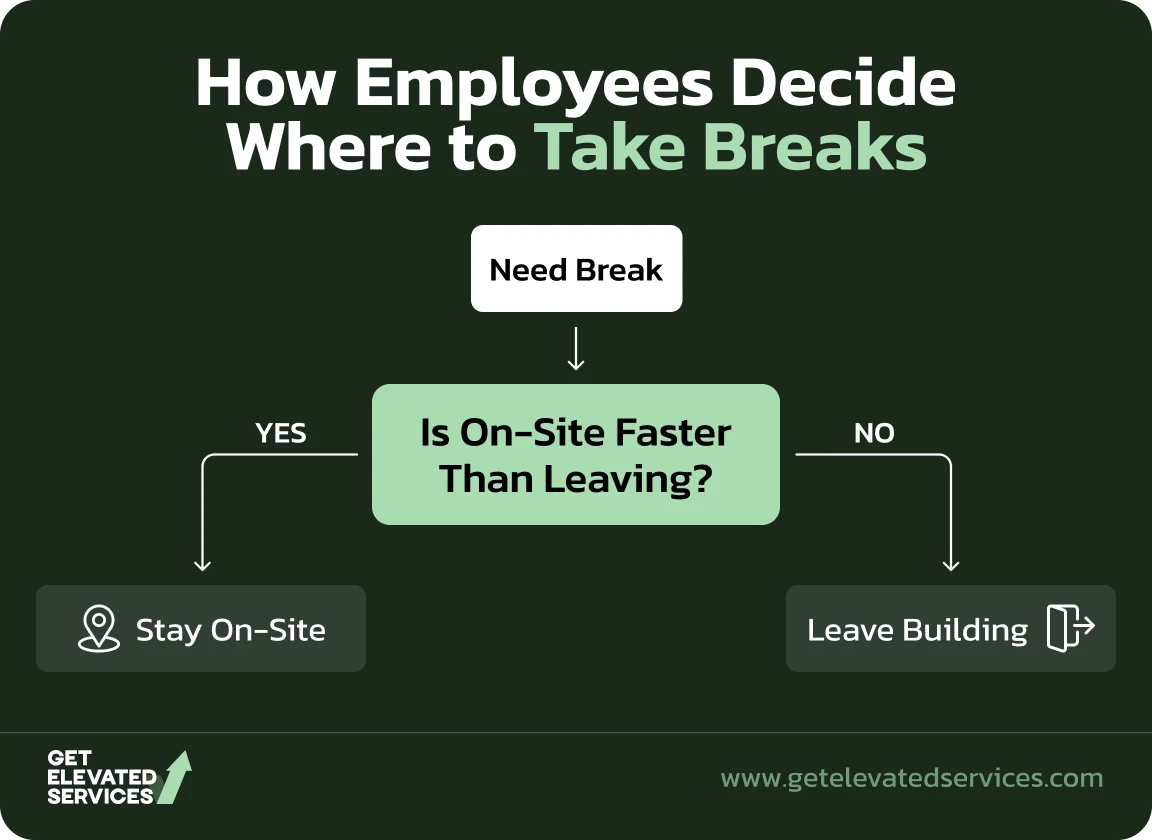
Employees evaluate effort subconsciously.
If leaving the building feels easier than accessing on-site resources, behavior shifts outward.
Key drivers include:
- distance to refreshments
- waiting time
- congestion
- reliability
When internal access is faster than external options, break duration shrinks naturally.
Reliability Builds Habit
Employees form routines around predictable environments.
If on-site access is inconsistent, empty machines, limited options, downtime, habits adjust quickly.
Once a routine of leaving forms, it becomes difficult to reverse.
Consistency is more powerful than variety.
Workflow Proximity
Break spaces that sit along natural traffic paths perform better than those isolated from operations.
Employees prefer minimal disruption:
- short walking distance
- no waiting lines
- easy payment
- clear accessibility
Proximity reduces break expansion.
Perceived Value of Time
Employees make break decisions based on perceived efficiency.
If leaving the building feels like an opportunity to combine errands, conversations, or personal time, breaks extend.
When convenience exists internally, breaks remain functional rather than exploratory.
Cultural Signals
Workplace design sends subtle messages about how breaks should function.
Well-designed environments encourage:
- quick reset
- short recharge
- structured pause
Poorly aligned spaces encourage:
- wandering
- extended absence
- workflow fragmentation
Design influences behavior more than enforcement.
Operational Benefits of On-Site Retention
When employees remain on-site:
- meetings resume on time
- coverage gaps decrease
- workflow remains stable
- response time improves
Small behavior shifts produce measurable operational consistency.
Conclusion
Employees stay on-site during breaks when convenience outweighs external options. The decision is rarely about motivation and almost always about environment.
Organizations that reduce friction naturally influence behavior without policy enforcement.


Other Blog Posts you Might Like

How Workplace Amenities Influence Employee Satisfaction


Why Workplace Breaks Are Getting Longer (And What Companies Can Do About It)

The Hidden Cost of Workplace Friction (And How to Reduce It)
Let’s Elevate Your Business
Whether you’re upgrading your breakroom, optimizing your vending program, or exploring new solutions - our team is here to help. Let’s connect and explore how GES can elevate your service experience.

.png)